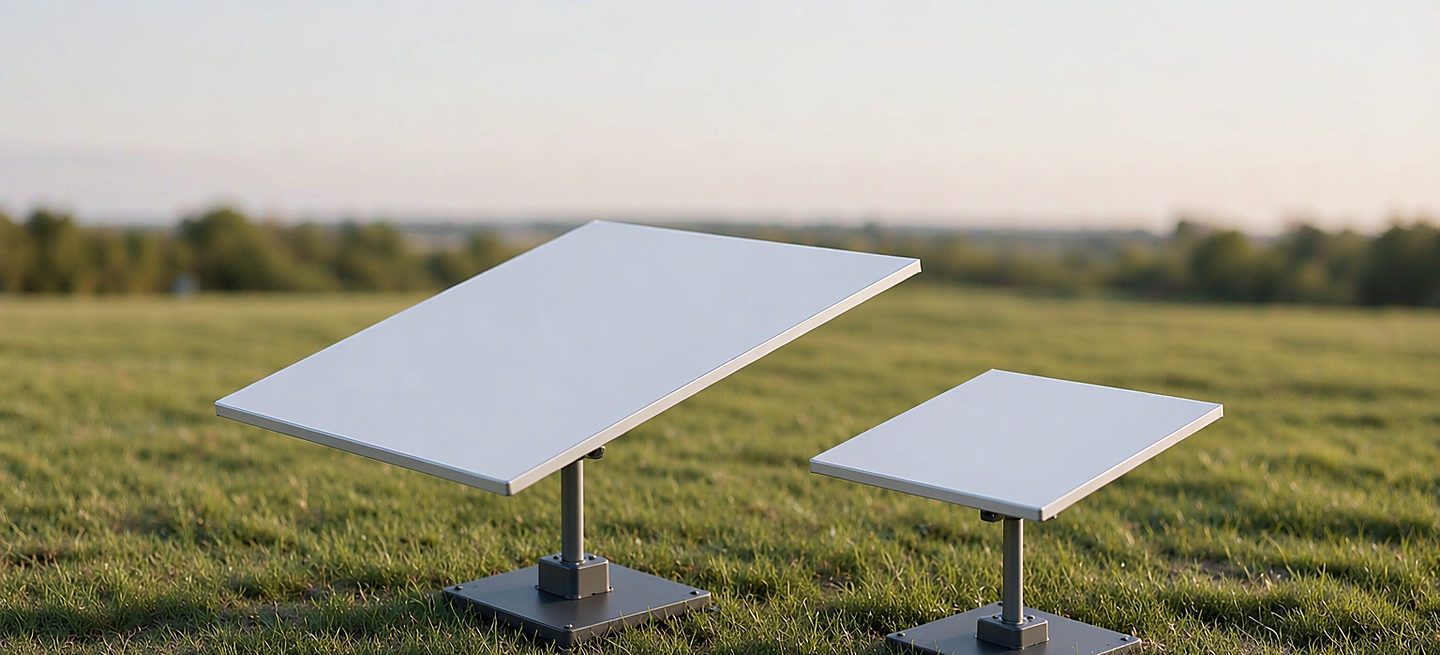
Short version: both dishes use the same 1.5-inch pipe thread, so any mount built around that standard will physically fit either one. What changes is weight and wind load — and that is the difference between a mount that lasts five winters and one that starts wobbling in its second.
Below is the comparison, then a decision table you can use in about thirty seconds.
The two dishes, side by side
| Standard (Gen 3 / V3 / Standard 4) | Mini | |
|---|---|---|
| Weight | ≈ 2 kg / 4.4 lb | ≈ 0.5 kg / 1.1 lb |
| Folded size | ≈ 23 × 15 in | ≈ 11.4 × 9.8 in |
| Mast interface | 1.5" pipe thread | 1.5" pipe thread |
| In the box | Ground base + power supply | Kickstand + integrated power |
| Typical use | Home, cabin, permanent installs | RV, van, boat, camping, backup |
| What you still need | A roof or wall mount | A clamp, magnetic, suction or pole solution |
If you own the Standard dish
You are mounting something roughly the size of a large pizza box that catches wind like one. That pushes you toward metal, mechanical fixings, and a mount that bolts or clamps rather than sticks.
| Your situation | What works | Why |
|---|---|---|
| House with a shingle or metal roof | Roof mount, bolted or clamped | Highest clear view, shortest cable run, best wind behaviour. |
| Steep roof, or you don't want roof penetrations | Wall / eave / fascia bracket | Loads go into the wall or fascia instead of the roof membrane. |
| Trees or buildings in the way | Pole mount on an existing post or a mast | Height solves obstructions; a mount that can't be repositioned never will. |
| RV or travel trailer | Rail clamp or through-roof plate | Needs to survive highway speed, not just park-up wind. |
If you own the Mini
The Mini is light enough that a completely different set of solutions opens up — and it's the more flexible machine, because you can move it between vehicles and campsites without tools.
| Your situation | What works | Why |
|---|---|---|
| You move it between vehicles and campsites | A freestanding tripod stand, or a tool-free clamp on a rack bar or ladder | Under a minute to fit or remove; no holes anywhere. |
| Steel roof or steel vehicle surface | Magnetic mount with a proper holding rating | Genuinely instant — but only on steel, and read the rating. |
| Glass sunroof or smooth panel | Suction mount | Tool-free and clean; requires a smooth, dust-free surface. |
| Tree cover at a fixed campsite | Telescoping pole with spike or hitch clamp | Gets the dish above the canopy, which is the only real fix. |
Once you know which dish you have, the next question is where it goes. The two-minute buying guide runs the decision tree; if the building should not be touched at all, start with the four no-drill options, or read what a freestanding stand can and cannot do.
The three mistakes that cost people money
1. Buying a mount without checking what it's rated to carry
Two mounts can look nearly identical and accept the same mast, while only one of them is rated for the heavier dish. Cheap universal clamps are the usual offender: they fit, then wobble, then the dish drifts out of its alignment and the "looking for satellites" message starts appearing at the worst time.
2. Mounting where the sky view is partly blocked
A dish that sees 80% of the sky does not deliver 80% of the performance. It drops out completely whenever a satellite crosses the blocked sector — which happens more often when the weather is bad and you need it most. Lower with a clear view beats higher with a tree in the way.
3. Trusting the surface more than the fastener
Timber takes a lag bolt. Brick and stucco take a sleeve anchor. Tile and slate need a bracket that spreads load without cracking the tile. A kit that ships "one bolt type for everything" is the kit you'll be re-tightening in a year.
FAQ
Do Gen 3 and Mini share the same mount?
The mast interface is shared — both are 1.5-inch pipe thread. Weight ratings are not. Buy to the heavier dish if you own both. What that shared thread saves you at checkout is its own topic: why you may not need a pipe adapter.
What mount comes in the box?
The standard dish includes a basic ground base; the Mini includes a kickstand. Neither is intended as a permanent roof, wall or vehicle mount.
Can I use a Mini mount with the Standard dish?
Physically it may attach, but don't. The Standard dish is roughly four times heavier and catches far more wind, which is exactly the load a Mini-rated mount isn't built for.
Will a third-party mount void my warranty?
No — the warranty covers the dish itself, not the way you mount it. A poor install that damages the dish is a separate question, which is why ratings matter more than price.
Do I need to buy a pipe adapter as well?
Only if the mount does not already end in the right thread. A pipe adapter exists to bridge a dish to a pole, and both current dishes take a 1.5 inch pipe thread. If the mount is built with that thread, there is nothing between the two to buy. Ours are built that way, and the tripod ships with the adapter in the box.
Not sure which dish you have?
Send us the model number from the label on the back of the dish, plus a photo of where you want to mount it. We'll tell you which option fits — or tell you that you don't need new hardware at all.
Starlink Roof Mount Kit
Fits both the Gen 3 and the Mini — the 1.5″ pipe thread is built in, so there's no pipe adapter to buy.