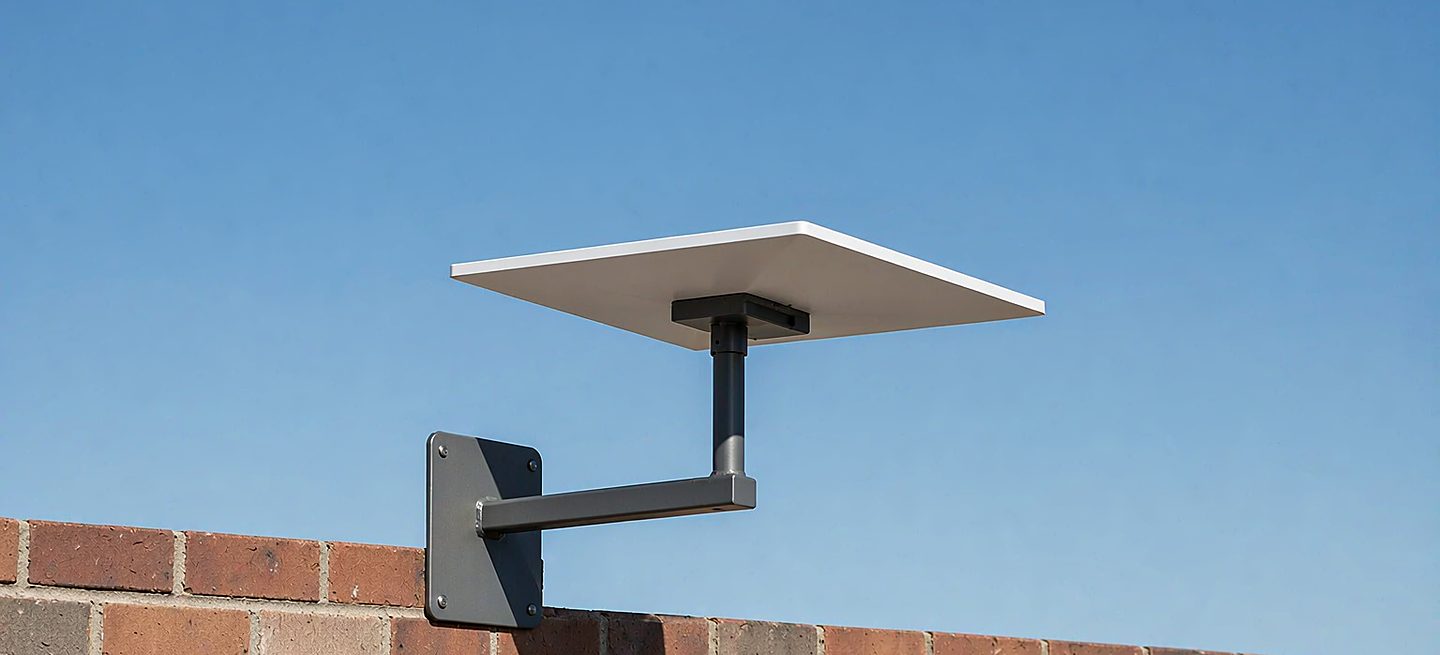
Most people overthink this. In practice there are only four places a dish ever goes, and the decision usually comes down to two questions: what surface do you have, and can you get a clear view of the sky from it?
Work through the table below. If you land on two options, pick the higher one — it's almost always the more durable install.
The two-minute decision tree
| Your situation | What you need | Why |
|---|---|---|
| You have roof rails or a flat, sturdy roof edge | Roof mount kit | Highest point, shortest cable run, minimal drilling in most cases. |
| Roof is metal, tile, or you don't want holes in it | Wall / eave bracket | Anchors into the wall face instead of the roof membrane, so you don't break the water seal. |
| Trees or buildings block the roof | Adjustable pole mount | Gets you above the obstruction and lets you fine-tune the angle without re-drilling. |
| Van, RV, tailgate, or you move often | Freestanding tripod stand | Nothing to drill, nothing bolted down, folds up and travels with you. |
Two of these four are the ones that need no holes at all — a stand and an eave bracket. If that is the direction you are heading, the breakdown of how to mount without drilling covers the trade-offs, and when a stand beats mounting anything covers the freestanding case in detail.
The three mistakes that ruin most installs
1. Mounting somewhere with a partial sky view
A dish that sees 80% of the sky doesn't perform at 80%. It drops out completely whenever a satellite crosses the blocked sector — usually right when the weather turns and you need it most. Better to mount lower with a clear view than higher with a tree in the way.
2. Using the wrong hardware for the surface
Every surface needs a different anchor. Timber takes a lag bolt. Brick and stucco take a sleeve anchor. Tile and slate need a bracket that spreads the load without cracking the tile. Mounts that ship with "one type of bolt for everything" are the ones that loosen in year two — which is the single most common cause of a dish drifting out of alignment.
3. Skimping on the finish
Mild steel painted black looks identical to powder-coated steel on day one. Two winters later, one has rust streaks running down your wall and the other doesn't. Coastal installs are the harshest test — salt air will find any bare edge. If you live within a few miles of the ocean, only consider stainless or marine-grade hardware.
How much mount do you actually need?
A rule of thumb from installs we've seen go wrong: if a ladder is required, buy the heavier option. A mount that's slightly overbuilt for a low roof is cheap insurance; replacing a mount on a two-storey roof is a weekend and a risk you don't want.
If your install is straightforward — ground floor, existing rails, short cable run — the standard kit is genuinely all you need. There's no reason to spend more.
One cost worth checking before you buy is the adapter that sits between the mount and the dish. It only exists to bridge the two, and both current dishes take a 1.5 inch pipe thread — so if the mount is already built with that thread, there is nothing between them to buy. Ours are built that way, and the tripod ships with the adapter in the box. If you are not certain which dish you have, the Gen 3 vs Mini comparison settles it with two tables.
Want the full round-up instead of a decision tree? Best Starlink mounts by type puts the roof kit, the wall bracket and the tripod side by side against the sites they fit.
Three deeper reads once you have the type: powering it off-grid, official vs third-party mounts, and where the money goes on a mount.
FAQ
Do I need a different mount for the Gen 3 and the Mini dish?
The mast interface is the same — both take a 1.5 inch pipe thread — so one mount physically fits both. What differs is load: the Standard dish is roughly four times heavier and catches far more wind, so buy to the heavier dish rather than to the fitting.
Can I mount a dish without drilling any holes at all?
Yes. A freestanding stand needs no fasteners at all, and an eave or fascia bracket keeps the roof membrane sealed. The trade-off with a stand is that wind load has to be carried by ballast or ground anchors instead of by bolts.
Is a roof mount or a wall bracket better?
It depends on the roof, not on the mount. Metal and tile roofs are the ones people least want to penetrate, which makes a wall or eave bracket the safer choice there. Where rails or a sturdy flat edge already exist, a roof mount gives the highest clear view and the shortest cable run. Which roof takes which fixing is set out in metal, shingle or flat.
How do I check whether my view of the sky is good enough?
Stand where you plan to install it and look at the sky from the dish's eye level, not yours. If anything solid crosses the frame between you and the horizon, you need height — which usually means a pole or a mast rather than a bracket.
Still not sure?
Send us a photo of where you plan to mount it, plus the model of your dish. We'll tell you which option to pick, or tell you that you don't need new hardware at all. It takes us about a minute and saves you a return.
Starlink Roof Mount Kit
The all-round permanent fix for homes with rails or a sturdy roof edge — highest view, shortest cable run, and no pipe adapter to buy.